Garmin Forerunner 165 Review: The Best Affordable AMOLED GPS Running Watch?
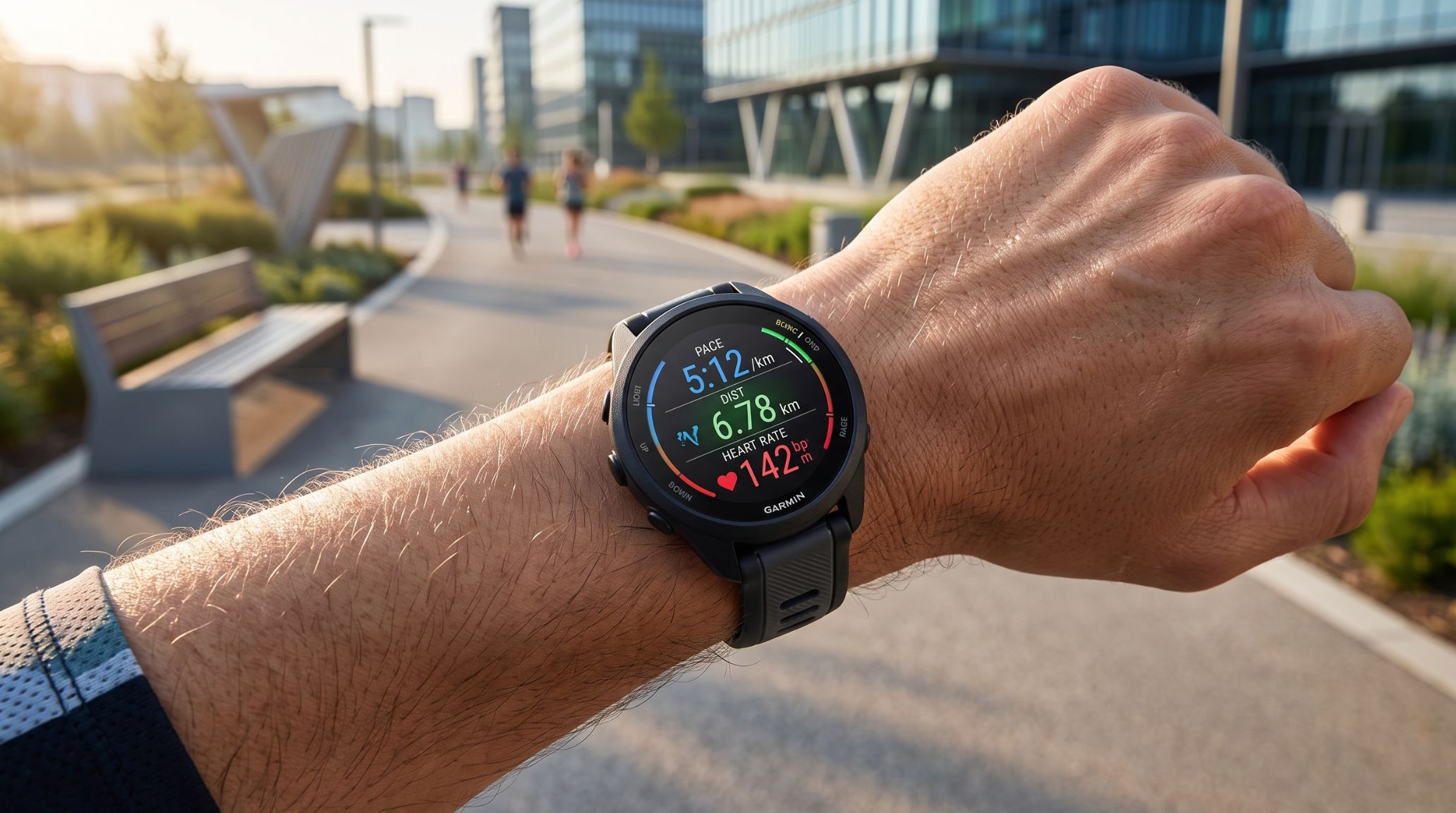
If you're looking for a running watch that gives you serious training data without jumping straight into the $400–$500 price range, the Garmin Forerunner 165 deserves a close look.
Garmin positioned the Forerunner 165 between the older Forerunner 55 and the more advanced Forerunner 265, but it doesn't feel like a stripped-down budget watch. You get an AMOLED touchscreen, multi-GNSS GPS, HRV Status, Body Battery, PacePro, running power, recovery information, sleep tracking, and Garmin's training ecosystem in a lightweight 43mm package.
And if you're considering buying one, there's another thing worth watching besides your training data: the price. Amazon prices can move during promotions and sales. A service such as PriceWhisper can help by tracking a product and notifying you when its price drops, so you don't necessarily have to buy the moment you find it.
⏱️ 60-Second Verdict
The Forerunner 165 hits the sweet spot for 90% of runners—offering a premium AMOLED screen, wrist-based running dynamics, and 11-day battery life without the $400+ price tag of higher-end models.
Not ready to buy? 🔔 Get a WhatsApp alert when the price drops.
Let's look at whether the Forerunner 165 is actually worth buying.
What Makes the Garmin Forerunner 165 Different?
The biggest upgrade is immediately visible.
The Forerunner 165 uses a 1.2-inch AMOLED display with a 390 × 390 resolution and approximately 1,000 nits of peak brightness. That's a major step up from the 1.04-inch, 208 × 208 MIP display used by the Forerunner 55.
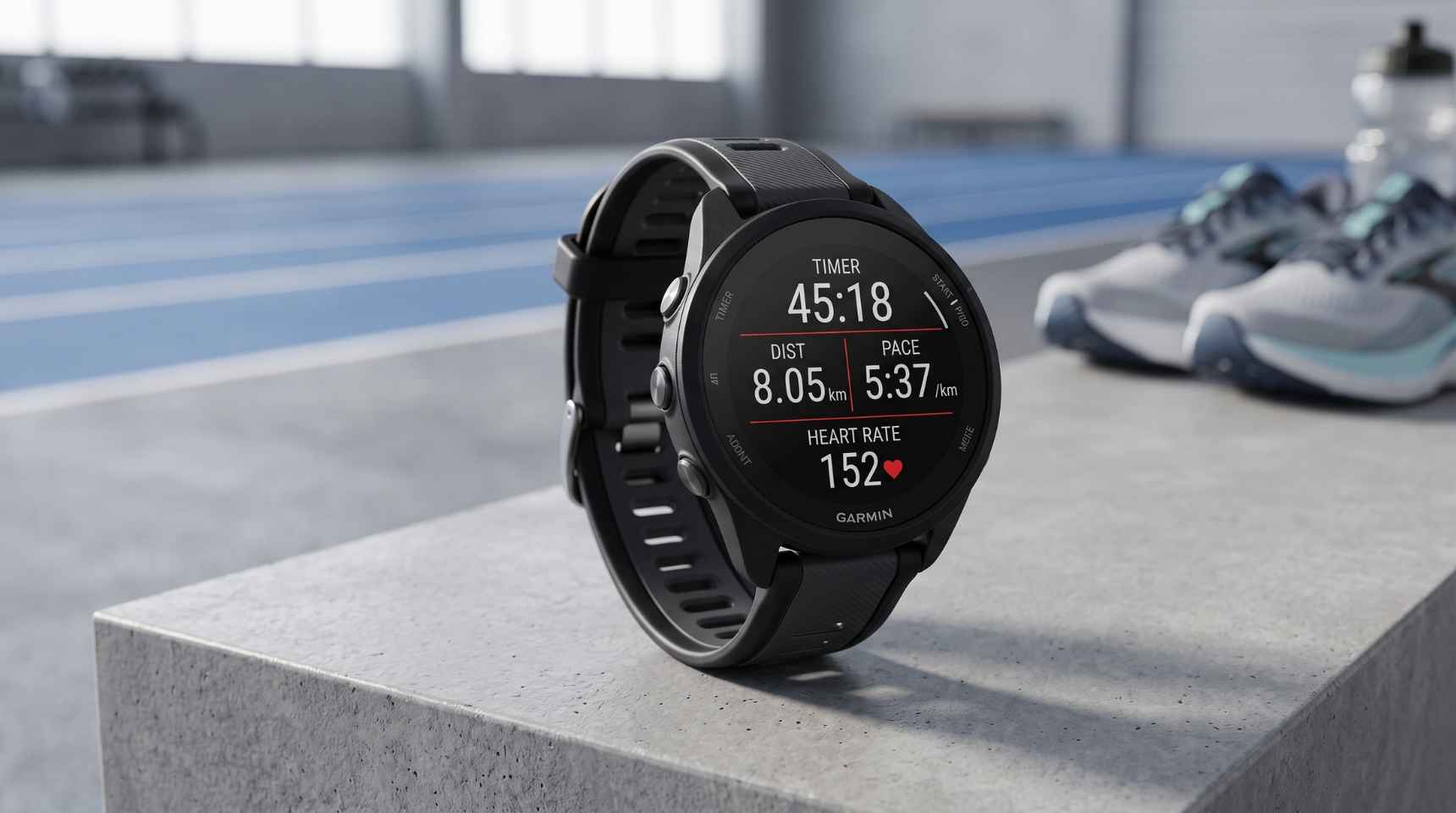
The result is a watch that feels considerably more modern.
Workout data, charts, notifications and menus are easier to read, while the deep blacks and vibrant colors of AMOLED make the watch look much closer to a premium smartwatch than an entry-level running computer.
But Garmin hasn't abandoned physical controls.
You get a five-button layout alongside the touchscreen, which is particularly useful when you're running in rain, sweating heavily or wearing gloves. Garmin disables the touchscreen by default during active workout profiles, allowing you to rely on the physical buttons instead.
That's a small design decision that matters once you're actually running.
It's Surprisingly Light
The Forerunner 165 comes in a single 43mm case measuring 43 × 43 × 11.6mm and weighs just 39 grams with the standard silicone strap.
That makes it particularly appealing if you intend to wear the watch around the clock.
A heavy watch can become annoying during sleep tracking or long workouts. The relatively low weight of the 165 makes it easier to keep on your wrist consistently—which is important because several of Garmin's health and recovery features become more useful when the watch has enough data to establish your personal patterns.
The Training Features Are Where the Forerunner 165 Gets Interesting
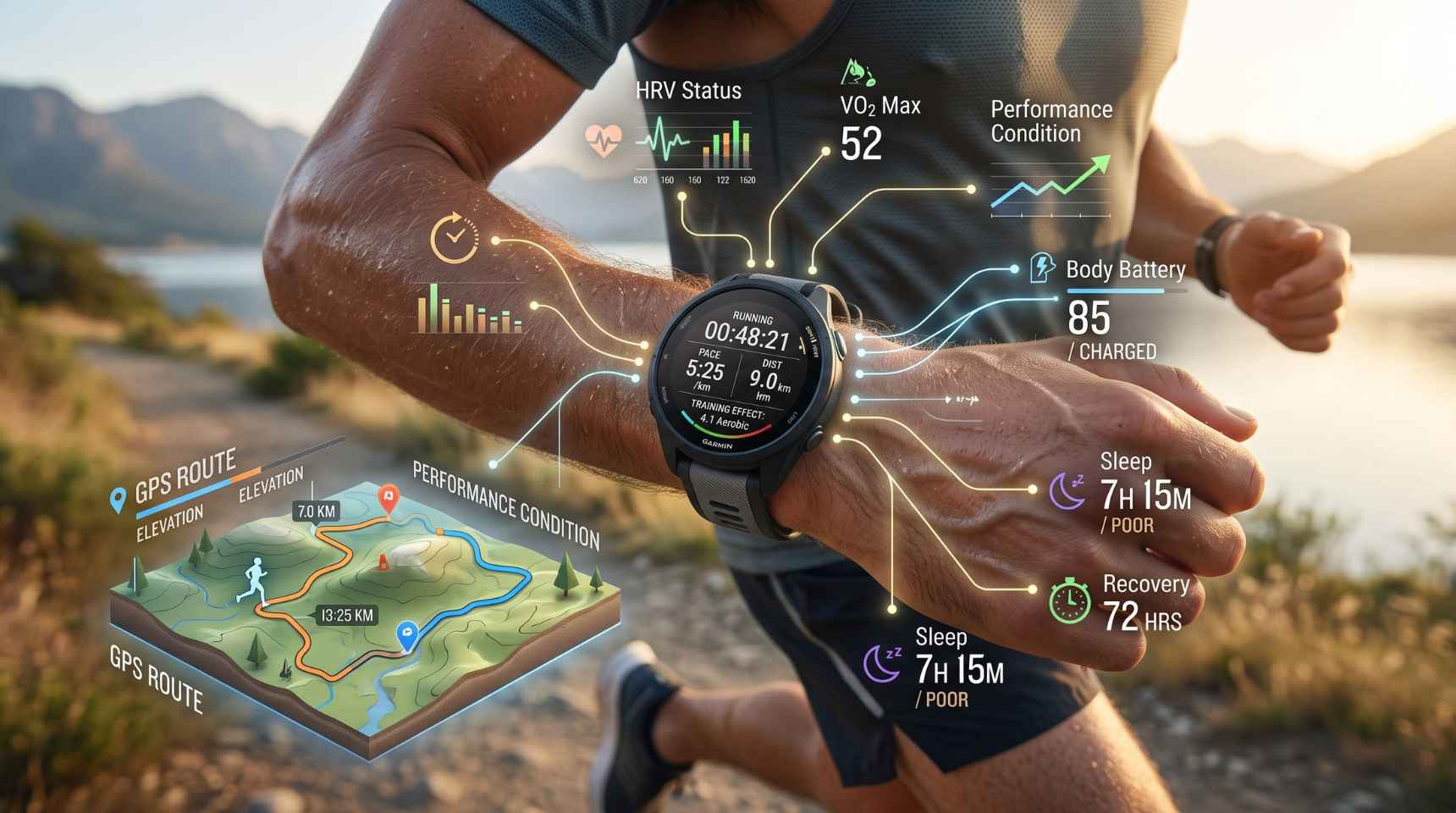
The display is nice, but the reason to buy a Forerunner is what happens underneath it.
The 165 combines its sensors with Garmin's physiological algorithms to turn raw data into useful training information.
HRV Status
The watch tracks heart-rate variability during sleep and requires approximately 19 days of continuous wear to establish a personalized baseline. It then compares a seven-day rolling average against that longer-term baseline.
Instead of obsessing over a single night's reading, you get a broader view of whether your recovery patterns are relatively balanced.
Body Battery
Body Battery turns several physiological inputs into a simple 0–100 energy-style score.
Garmin's system combines factors such as overnight HRV, sleep, stress and physical activity to estimate how much energy you have available throughout the day.
It's particularly useful for someone trying to balance running with work, university, family life or other daily demands.
Morning Report
The Morning Report brings several pieces of information together when you wake up.
Depending on your configuration, it can show your Sleep Score, HRV Status, Body Battery, weather and suggested workout information.
Rather than opening multiple screens and apps, you get a quick snapshot of how the previous night went and what Garmin thinks you should do next.
PacePro Is One of the Best Features for Race Day
One feature that can make the Forerunner 165 especially attractive to runners training for a race is PacePro.
Traditional pacing assumes every kilometer or mile is equally difficult.
Real courses obviously aren't.
You might have a steep climb halfway through a 10K followed by a downhill section. Trying to maintain exactly the same pace throughout can result in wasting too much energy on the climb.
PacePro uses elevation information to create grade-adjusted pacing targets, allowing you to slow down appropriately on climbs and compensate elsewhere.
For runners who like structured pacing strategies, that's a considerably more useful feature than simply watching your average pace.
You Also Get Wrist-Based Running Power
The Forerunner 165 can calculate running power directly from the wrist.
Running power is expressed in watts and attempts to represent the mechanical effort you're producing while running. Unlike heart rate, which can take time to respond to a sudden change in effort, power can react more immediately to changes such as hills and wind.
The watch also provides running dynamics such as:
Cadence
Stride length
Vertical oscillation
Ground contact time
For casual runners, these numbers aren't necessarily something you need to analyze every day.
For runners who enjoy digging into performance data, however, they provide another layer of information to work with.
Garmin Coach Can Help If You Don't Have a Running Coach
The Forerunner 165 supports Garmin Coach training plans for 5K, 10K and half-marathon goals.
You select your goal, preferred training days and other parameters, and Garmin generates a structured training plan that can adapt as your training progresses.
There's an important caveat, though.
The research also notes criticism from some endurance users regarding Garmin Coach's rigidity, including complaints that the system can be overly conservative or prescribe more running than some beginners want.
So think of Garmin Coach as a useful training assistant—not a replacement for a human coach.
What the Garmin Forerunner 165 Doesn't Have
This is where you need to be realistic.
The Forerunner 165 isn't designed to replace Garmin's higher-end Forerunner 265.
It deliberately leaves out several premium features, including:
Native multisport/triathlon mode
Training Readiness score
Training Status and Acute Load
Cycling power-meter support
Multi-band GPS
The lack of multi-band GPS is particularly relevant if you frequently run through dense city environments, where buildings can create GPS signal reflections.
For ordinary suburban and open-road running, however, the standard Multi-GNSS system remains highly capable according to the research.
So the question isn't whether the 165 has every feature Garmin offers.
It doesn't.
The better question is whether you actually need those missing features.
For many runners, the answer will be no.
Garmin Forerunner 165 vs Forerunner 265
The Forerunner 265 is the obvious upgrade.
It gives you multi-band GPS, triathlon functionality and additional physiological analytics, but the research places it at roughly $200 more than the Forerunner 165.
That creates an interesting value proposition.
If you're a competitive triathlete, use a cycling power meter or regularly run in environments where multi-band GPS matters, the 265 may justify the additional expense.
But if you're primarily a runner training for 5Ks, 10Ks, half-marathons or general fitness, the 165 gives you most of the features you're likely to actually use.
The research estimates that it provides roughly 85% of the Forerunner 265's functionality at nearly half the financial outlay for the relevant use case.
That's difficult to ignore.
What About the Apple Watch SE?
The Apple Watch SE makes more sense if your priority is general smartwatch functionality and deep integration with the Apple ecosystem.
But for dedicated running, the Forerunner 165 has some significant advantages.
The research compares the Apple Watch SE's roughly 18-hour battery life with up to 11 days of smartwatch battery life for the Forerunner 165.
That difference becomes important if you want continuous sleep and recovery tracking.
Charging every day creates opportunities to leave your watch on the charger precisely when you want it collecting data.
The Forerunner 165 is much more oriented toward being worn continuously.
Battery Life Is a Major Selling Point
Garmin rates the Forerunner 165 for up to 11 days in smartwatch mode.
Turn on Always-On Display and the quoted figure falls to around four days.
For continuous GPS tracking, Garmin rates it for up to 19 hours, with battery life falling further when additional satellite systems and music playback are used simultaneously.
Real-world usage naturally varies.
The research cites approximately 5–7 days for users recording around four to six hours of GPS activity per week with Always-On Display and Pulse Ox disabled.
For a runner, that's still a substantial advantage over a smartwatch that needs daily charging.
Is the Garmin Forerunner 165 Worth Buying?
For the right runner, yes.
The Forerunner 165 manages to combine several things that don't usually come together at this price:
A premium-looking AMOLED display + serious running metrics + strong battery life + Garmin's training ecosystem.
Its $249.99 standard price in the research put it in an interesting position between basic running watches and Garmin's considerably more expensive models.
The biggest question is what type of athlete you are.
The Forerunner 165 makes sense if you:
Primarily run rather than compete in triathlons
Want an AMOLED display
Want detailed running metrics
Care about sleep and recovery tracking
Want long battery life
Want structured training tools
Don't need multi-band GPS
Don't need cycling power-meter support
You may want something else if you:
Compete seriously in triathlons
Need multi-band GPS
Use cycling power meters
Want Garmin's most advanced training analytics
Prefer a general-purpose smartwatch over a dedicated running watch
For most recreational and intermediate runners, though, the 165 hits a very attractive middle ground.
Before You Buy: Don't Ignore the Price
At this point, you've probably decided whether the Forerunner 165 belongs on your shortlist.
If it does, check the current Amazon price before purchasing.
The research notes that Amazon can reflect promotional pricing and retailer discounts, meaning the price you see today isn't necessarily the price you'll see later.
[Check the Garmin Forerunner 165 on Amazon]
And if you're not in a rush, this is where PriceWhisper can be useful.
Instead of repeatedly checking the product page yourself, you can send the Amazon product link to PriceWhisper and let it monitor the price. When the tracked price drops, you're notified through WhatsApp.
That can be particularly useful for a product like the Forerunner 165, where even a modest percentage discount can mean keeping a meaningful amount of money in your pocket.
Final Verdict
The Garmin Forerunner 165 is one of those products where you don't necessarily need to spend more to get the features that matter most.
You get a sharp AMOLED display, five-button controls, multi-GNSS GPS, Elevate Gen 4 heart-rate tracking, HRV Status, Body Battery, sleep tracking, PacePro, wrist-based running power, Garmin Coach and long battery life—all in a 39-gram package.
It's not Garmin's ultimate running watch, and that's precisely the point.
It doesn't need to be.
For runners who want serious training capabilities without paying for features they'll never use, the Forerunner 165 is a compelling option.
If the current Amazon price looks good, it's worth considering. If it doesn't, there's little reason to rush.
You can check the current price here:
[Check Garmin Forerunner 165 on Amazon]
And if you're willing to wait for a better deal, PriceWhisper can monitor the product for you and send a WhatsApp alert when the price drops—a simple way to avoid paying more just because you happened to shop on the wrong day.
Disclosure: This article contains affiliate links. If you purchase through an affiliate link, we may earn a commission at no additional cost to you.
Never Overpay Again On Amazon & AliExpress!
Save money using PriceWhisper by tracking Amazon & AliExpress product prices directly using our WhatsApp bot. Just send us a product link!
Track on WhatsApp